
Metal Bandsaws for sale Australia
Metal band saws are essential industrial metal cutting machines used in steel fabrication, engineering workshops, manufacturing plants and processing facilities across Australia. Whether you require a fully automatic metal saw for high-volume production cutting, a semi-automatic metal bandsaw for daily fabrication, or a manual metal bandsaw for workshop use, Power Machinery supplies premium industrial metal band saws built for performance, reliability and precision.
If you’re searching for metal bandsaws for sale in Australia, we provide expert advice, installation, training and after-sales support nationwide. Call (02) 8445 8555 to find the best metal band saw solution for your business.
Trusted Australian Supplier
Supplying industrial metal band saws across Australia to fabrication, manufacturing and engineering workshops.
Industrial Grade Global Brands
Premium metal saws from leading European and North American manufacturers including MEP and Hydmech.
Installation and Technical Support
In-house service department with full installation, commissioning and operator training available Australia-wide.
Finance & Flexible Purchasing
Finance options available to help workshops invest in the right metal cutting equipment for your needs.
Nationwide Delivery
Metal bandsaws delivered and supported across Sydney, Melbourne, Brisbane, Perth, Adelaide and regional Australia.
Whether you need a manual metal band saw for workshop use or a fully automatic industrial metal saw for production cutting, our team can recommend the right solution for your business.
What is a Metal Bandsaw?
A metal bandsaw is a precision cutting machine that uses a continuous toothed blade running around two wheels to cut steel, aluminium and other metals. Metal-cutting bandsaws are commonly horizontal (either pivot/scissor or column-guided) or vertical, depending on the application.
Not all bandsaws are built alike. Frame rigidity, blade guidance, clamping, drive system and feed control all influence cut straightness, blade life and productivity.
A quality metal bandsaw delivers:
- Straight, repeatable cuts with minimal burr, ready for welding or machining
- Broad capacity: RHS/SHS, angle, channel, beams, pipe, solids, and bundles
- Excellent material utilisation thanks to a narrow kerf
- Low heat input compared with thermal cutting processes, minimising heat-affected zones in the material
- Controlled cutting with flood coolant, minimum-quantity lubrication (MQL), or dry cutting where appropriate
- Manual, semi-automatic and fully automatic options, with features such as hydraulic clamping and feed, shuttle vices, and NC/CNC indexing on production models
In short, a metal bandsaw is the flexible backbone of a fabrication workflow, from first cut to final fit-up.
Metal bandsaws are the common choice for:
- Structural steel fabrication
- Pack cutting of sectional steel and solid bar
- Pipe and tube cutting
- Stainless steel processing
- Production bar cutting
They’re available in manual, semi-automatic and fully automatic configurations to suit everything from workshop maintenance to high-volume industrial production.
Metal Bandsaw Comparison Table
Manual vs Semi-Automatic vs Automatic Metal Bandsaws
| Feature | Manual | Semi-Automatic | Automatic |
|---|---|---|---|
| Best For | Occasional/low volume cutting | Daily fabrication/mixed work | Repetitive batch/high volume production |
| Operator Involvement | Operator sets, clamps and cycles each cut | Operator positions material; machine clamps and completes the cut cycle | Operator loads and programs the job; machine indexes, clamps and cuts automatically |
| Material Feeding | Manual | Manual positioning | Automatic indexing/shuttle vice |
| Clamping | Manual or powered, depending on model | Powered/hydraulic | Automatic; bundle clamping available on many models |
| Cutting Cycle | Operator controlled | Automatic saw cycle after operator start | Programmed repeat cycles/cut lists |
| Production Speed | Cutting rate depends on blade, material and machine; overall productivity is lowest because the operator handles each cycle | Similar cutting physics, but less operator handling between cuts | Highest overall throughput through automatic indexing and repeat cycling |
| Repeatability | Operator dependent | Good | Excellent for repeated lengths |
| Ideal Workshop Type | Maintenance, jobbing and occasional cutting | General fabrication and mixed work | Manufacturing, repetitive production and steel processing |
| Labour Efficiency | Low | Medium | High |
| Investment | Lowest | Mid range | Highest |
Horizontal vs Vertical Metal Bandsaws
When choosing a metal bandsaw, one important decision is whether a horizontal or vertical cut-off configuration best suits the work. Both use a continuous toothed blade, but their machine layout changes how material is loaded, supported and mitred.
Horizontal cut-off bandsaws are the most common style. They are generally either pivot/scissor machines, where the saw bow swings down around a pivot, or column-guided machines, where the head travels vertically on one or two columns. Both styles are available for straight and mitre cutting of bar, structural sections, pipe and tube. Depending on the design, horizontal saws range from compact jobbing machines through to large automatic production saws with capacities around 1,000 x 1,000 mm and beyond.
Vertical metal bandsaws fall into two broad categories: vertical cut-off/tilt-frame saws and contour saws. Contour bandsaws are used in toolrooms and pattern work and resemble vertical woodworking bandsaws: the workpiece is supported on a table and manually guided through the blade. Metalworking contour saws often include a blade cutter and welder, allowing the blade to be passed through a drilled hole and re-welded for internal profile cutting.
Contour-style vertical bandsaws are less common than they once were, as EDM, laser and other profile-cutting processes have taken over many applications.
Vertical cut-off or tilt-frame saws are relevant, particularly for larger structural sections and awkward workpieces. The material sits on a bed in front of the blade and the saw head advances through it.
Commonly used for larger-capacity work, vertical bandsaws offer several practical advantages:
1. Material handling. With an open work area in front of the blade, material can often be lowered directly into position by crane or forklift instead of being rolled in from one end.
2. Mitre adjustment. On many vertical saws the head tilts to the programmed angle rather than swinging a large bow through an arc, making angle changes fast and keeping material handling simple.
3. Floor space. A vertical cut-off saw can occupy substantially less floor area than a horizontal machine of equivalent cutting capacity.
4. Special applications. The open bed makes it easier to remove standard vices and install purpose-built fixtures for awkward components, such as bent or pre-formed tube and pipe.
5. Raft cutting. Long sections such as RHS or SHS can be laid side-by-side across the bed and cut together. For mitre work, this can help keep multiple parts at a common finished length without repeatedly repositioning individual sections.
For a full comparison, read our detailed guide: Horizontal vs Vertical Metal Bandsaws in Australia
| Feature | Horizontal Metal Bandsaw | Vertical Cut off/Tilt Frame Bandsaw |
|---|---|---|
| Cutting Action | Material clamped; pivot or column-guided saw head moves through the workpiece | Material clamped on an open bed; vertical saw head advances through the workpiece |
| Primary Use | General straight and mitre cutting of bar, tube, pipe and structural sections | Larger structural sections, awkward workpieces, raft cutting and heavy fabrication |
| Mitre Capability | Single or double mitre depending on model, commonly up to 60° | Powered or programmable left/right mitre available on many models |
| Bundle Cutting | Yes - bundle clamps available on suitable models | Yes - overhead or purpose built bundling available on suitable models |
| Capacity Profile | Very broad range, from compact workshop saws to large production machines | Generally medium to large capacity and heavy-duty applications |
| Automation Options | Manual, Semi-Automatic & Automatic | Primarily semi-automatic and automatic |
| Material Handling | Stock commonly moves longitudinally on roller tables; shuttle indexing on automatic models | Open work area suits crane/forklift loading and purpose-built fixtures; roller tables can also be used |
| Typical Workshop | General fabrication through to steel processing | Heavy fabrication, structural steel and larger or awkward components |
| Price Range | Wide price range from economical manual machines to high-output automation | Usually a higher entry price because these machines are generally larger and heavier-duty |
| Ideal For | Bar, pipe, tube, structural sections and repetitive straight/mitre work | Large sections, beams, awkward shapes, raft cutting and applications needing open-bed loading |
Horizontal Pivot vs Dual Column
Within horizontal bandsaws, there’s a further choice between two frame designs:
- Horizontal pivot saws (sometimes called scissor-action saws) – swing the bow up and down around a pivot point. They’re compact, cost-effective, and well suited to general fabrication, structural work, maintenance and small production lots.
- Dual-column (double-column) saws – guide the saw head between two rigid columns rather than around a pivot. Depending on the model, the blade may be horizontal or slightly canted. The extra rigidity and controlled head travel make this design well suited to solid material, difficult-to-cut alloys, larger sections and high-repeatability production cutting.
Mitre Capability: Single vs Double
- Single mitre: the head or vice rotates to one side (commonly 0–60°). Suits handrail, frames, and general fabrication work.
- Double mitre: cuts left and right without flipping long stock, which is faster, safer, and more accurate for repetitive angle work. Particularly useful when material is awkward to flip for the opposite mitre.
Buying Guide: How to Choose the Right Metal Bandsaw
Selecting the correct metal cutting saw depends on required capacity, production volume, material type, accuracy, mitre requirements, material handling and budget.
Jump to: Capacity & Footprint · Production Volume · Material Type · Accuracy· Mitre Cutting · Blade System · Speed & Feed Control · Vice & Material Handling · Coolant & Cleanliness · Controls & Connectivity · Budget and Labour Savings
Capacity & Footprint
The following points apply across manual, semi-automatic and automatic bandsaws:
- Consider the maximum section or pack size you need to cut.
- Check round, square, and rectangular capacities at 90° and at common mitres (45°, 60°) — not just the straight capacity.
- If mitre cutting is required, check the capacity at 45°. A saw rated at 510 x 320mm straight may only cut 350 x 320mm at 45°.
- If occasional oversized pieces are the exception rather than the rule, consider applying a 90% rule. Size the saw for your typical work and cut outlying larger sections by plasma or oxy.
- Bandsaw prices escalate quickly beyond 350mm diameter capacity, so weigh up the return on investment carefully before sizing up.
- Make sure the saw physically fits your space, with roller tables or infeed/outfeed conveyors accounted for on long stock.
Production Volume
- Occasional or job-based cutting – Manual metal bandsaw
- Daily workshop cutting – Semi-automatic bandsaw
- Continuous batch production – Automatic metal bandsaw
On equivalent machines, automation does not inherently make the blade cut through the material faster. Cutting rate is governed by the material, blade, machine power, feed settings and chip evacuation. What automation changes most is the time and labour required between cuts.
A semi-automatic saw automates functions such as clamping, head feed and return, reducing handling within each cycle. An automatic saw also indexes the material to the programmed length and repeats the cutting cycle, freeing the operator for other work.
Material Type
Consider:
- Solid bar vs structural sections
- Pipe and tube cutting
- Mild steel, stainless steel, aluminium, tool steel, hardened material and other difficult to cut alloys
Required Accuracy
If you need:
- High repeatability
- Batch cutting of identical parts
- CNC angle cutting
An automatic or CNC metal saw may be the best option.
Mitre Cutting
- Manual, semi-automatic, and automatic bandsaws are all available in straight-cutting or mitre-cutting versions.
- Straight-cutting (non-mitre) machines often have a smaller footprint and can offer greater rigidity, which is useful for solid bar and difficult-to-cut materials.
- If you regularly cut left and right mitres for frames or structural work, a saw with programmable mitring can significantly reduce material handling time and improve efficiency.
- Non-mitre machines are not necessarily cheaper than mitre versions.
- On automatic saws, straight-cutting models can also achieve a shorter remnant length – the final offcut that cannot be automatically fed through – although this varies by machine design.
Blade System
- Blade size (length, width, thickness) and tooth pitch options determine what you can cut and at what feed rates.
- Bi-metal blades are the workhorse for mild steel and stainless; carbide excels on large solids and superalloys.
- Look for carbide or hardened guides, an effective chip brush, and accurate tensioning — often with a gauge.
Speed and Feed Control
- Variable blade speed (inverter or gearbox) is essential when cutting different materials.
- Hydraulic downfeed with fine control — and pressure/flow separation – protects blades and ensures surface finish.
- On advanced machines, servo-controlled feed and auto feed-rate optimisation maintain cut quality and blade life.
Vice and Material Handling
- Bundle clamps keep packs rigid – critical for straightness and blade life.
- Hydraulic or servo downfeed with independent control of feed force and feed rate protects the blade and helps maintain cut quality.
- Fast-acting clamps reduce cycle time.
Coolant, Chips and Cleanliness
- A reliable flood coolant system with adjustable nozzles improves finish and blade life.
Removable chip trays, effective chip brushes and chip conveyors simplify housekeeping and maintenance.
For aluminium and some fabrication applications, minimum-quantity lubrication (MQL) can be a clean, effective alternative to flood coolant.
Controls and Connectivity
- Manual controls should be intuitive; semi-auto/auto machines benefit from program storage, cut counters, and length correction.
- On higher-spec machines, look for diagnostics, error logging, and safety interlocks.
Budget vs Labour Savings
While automatic metal bandsaws require higher upfront investment, they:
- Reduce labour costs
- Increase overall throughput
- Improve cut consistency
- Reduce material waste
Part length has a major effect on the return from automatic indexing. An 8.0 m bar cut into 200 mm parts can run through many cycles before the operator needs to reload; if the parts are 3,000 mm long, only a few cuts are possible before a new bar is required. The shorter and more repetitive the parts, the greater the potential labour saving.
MEP vs HYDMECH: how to think about the brands
- Both MEP (Italy) and Hydmech (North America) are global leaders with deep product lines that cover manual to fully automatic production machines.
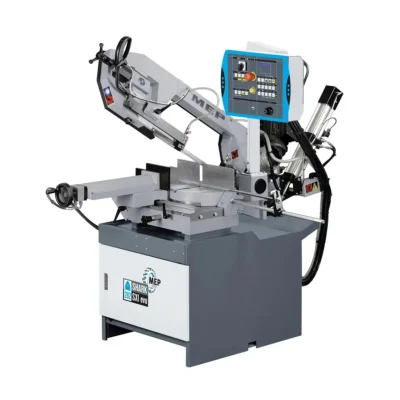
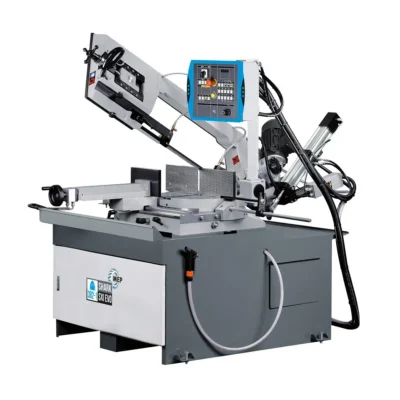
- MEP is well-known for compact footprints, strong double-mitre capability, ergonomic design and a broad range of manual, semi-automatic and automatic saws
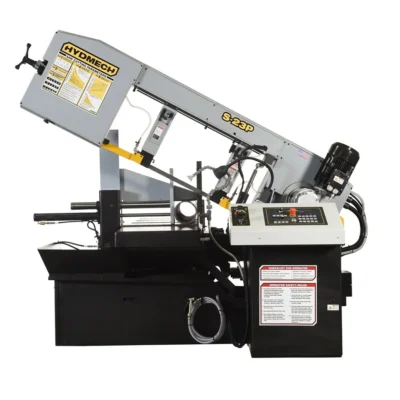
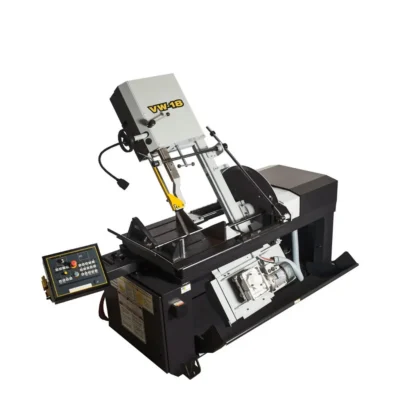
- Hydmech is renowned for rock-solid frames, dual-column precision, and highly productive automatic lines found in serious steel processing environments.
Which is right for you? It depends on your work mix, space, throughput targets, and budget. Power Machinery supplies both—so our advice is brand-agnostic and centred on your ROI.
When to Choose MEP or Hydmech
- Choose MEP when you need nimble, high-value machines: compact double-mitre horizontals for fabrication bays, semi-auto productivity without a big footprint, and smart mechanics that punch well above their size.
- Choose Hydmech when your priority is uncompromising precision and volume: dual-column accuracy, powerful automatic indexing, and the robustness demanded by processing centres and structural steelworks.
Selecting the right band saw for metal: A quick framework
Use these questions to narrow down the right machine:
- What are you cutting 80% of the time?
Mild steel tube? Structural I-beam? 316 stainless? Tool steel solids? Your dominant material should drive blade type, speed range, and machine rigidity. - What sizes and lengths?
Map the biggest round/square/rectangular sections you cut. If you regularly mitre, note the angles and length of stock; double mitre can save hours per week. - What throughput do you need?
How many cuts per day or shift? If an operator spends several hours each day at the saw, semi-automatic or automatic equipment should be evaluated on the labour savings and extra throughput it can deliver. - Who will run it?
Skilled trades, apprentices, or rotating operators? Simple, repeatable controls reduce training time and scrap. - Floor space and flow
Plan the roller tables, loading space, and safe egress around the saw. Good layout prevents bottlenecks. - Future growth
If you might add bundle cutting or longer bar feeds later, choose a platform that can scale (conveyors, stop systems, integration).
Our range of Metal Bandsaws for Sale
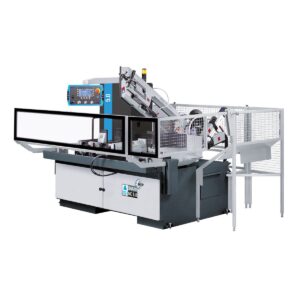
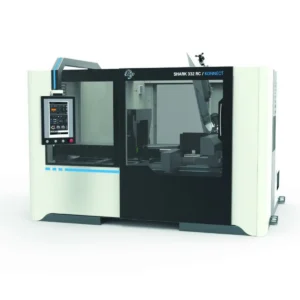
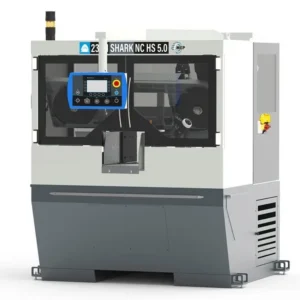
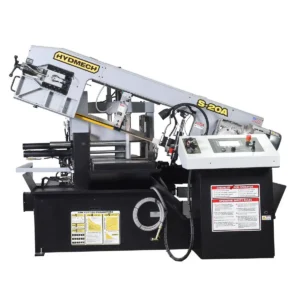
Automatic Metal Bandsaws
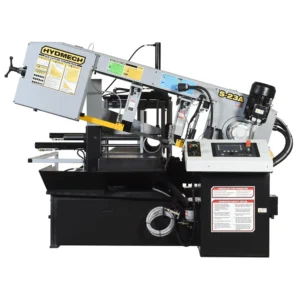
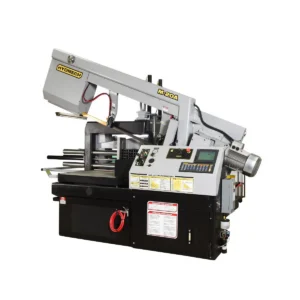
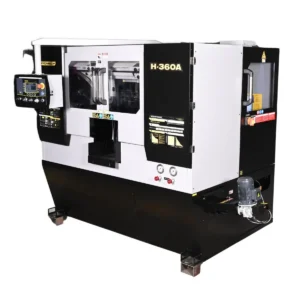
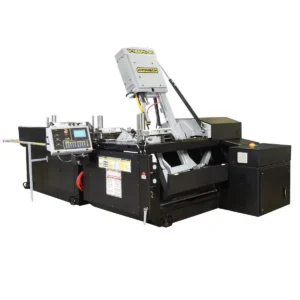
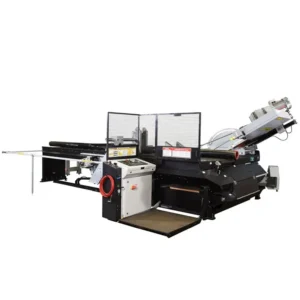
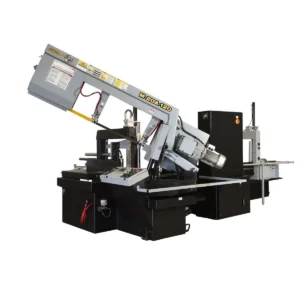
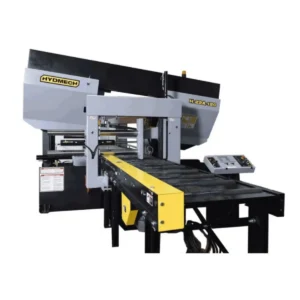
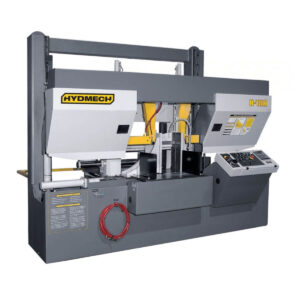
Automatic bandsaws are designed for fast, continuous cutting with minimal operator involvement. These machines handle feeding, clamping, and cutting automatically, delivering high-volume productivity with consistent accuracy. Ideal for manufacturing and fabrication environments, our automatic bandsaws shine when repeatability and efficiency are essential. They allow your team to focus on other tasks while the saw does the heavy lifting, maximising throughput and reducing labour costs.

Semi-Automatic Metal Bandsaws
Semi-automatic metal bandsaws offer the perfect balance between operator control and machining efficiency. These saws automatically manage clamping and cutting, while the operator positions the material between cuts. This combination delivers excellent precision and flexibility, making semi-automatic models ideal for mixed production environments. They’re the go-to solution for workshops that want power and consistency without the full automation price tag.


Manual Metal Bandsaws
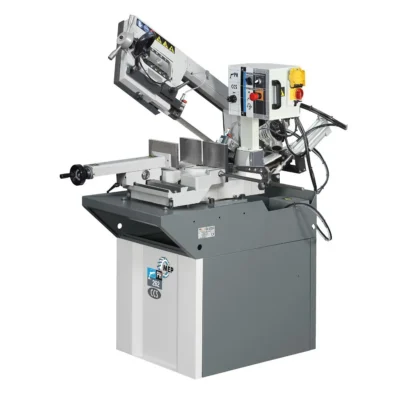
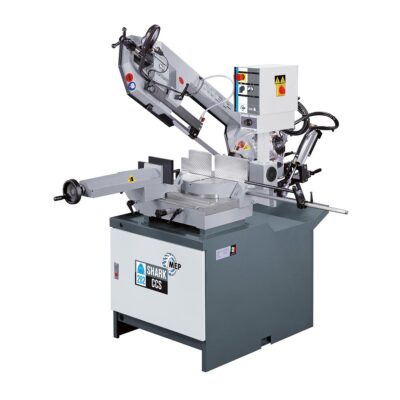
Manual bandsaws give operators complete hands-on control, making them ideal for low-volume, customised, or irregular cutting tasks. These machines are built for reliability and ease of use, allowing you to adjust, position, and cut material with confidence. Manual models excel in workshops where versatility and operator skill are key advantages. With robust construction from manufacturers such as MEP and Hydmech and intuitive operation, manual bandsaws remain a trusted essential for smaller fabrication jobs and maintenance work.


Safety and compliance essentials (Australia)
A metal band saw is a powerful machine tool. Key safety considerations include:
- Risk assessment, machine isolation and lock-out/tag-out procedures
- PPE appropriate to the task, including safety glasses and hearing protection; use cut-resistant gloves for material or blade handling only when the machine is stopped and isolated
- Guarding and safety interlocks kept in place, maintained and never bypassed
- Coolant management: slip prevention, skin safety, and correct disposal
- Operator training covering normal operation, blade changes, tensioning, guide setting, material handling and safe mitre cutting
- Housekeeping: chip build-up is a hazard—use the chip brush, trays, and vacs
The manufacturer’s manual, your workplace risk assessment and applicable WHS requirements should remain the primary safety references. Our team also covers safe commissioning and operating practices at handover.
Get the most from your saw: Setup, blades & maintenance
Installation and Alignment
- Level the base and ensure the floor is stable.
- Square the vice and check factory settings for guide arms.
- Confirm coolant lines are free, primed, and aimed at the cut zone.
Blade selection & Break-in
- Match tooth pitch to wall thickness and section size. Too coarse a pitch on thin-wall tube can snag and strip teeth; too fine a pitch on large solids can pack the gullets with chips and shorten blade life.
- Break in new blades using the manufacturer’s recommended blade speed and a reduced feed rate or feed pressure. Correct break-in can substantially extend blade life.
Daily Checks
- Tension and guide arm position
- Chip brush contact with the blade
- Coolant level and concentration (use a refractometer)
- Clean vice faces and bed—chips under workpieces cause inaccuracy
Troubleshooting at a Glance
- Wandering cuts: check blade sharpness, guide alignment, vice clamping, and feed rate.
- Tooth stripping: tooth pitch too coarse for thin material, feed too aggressive, poor clamping, or the blade entering an interrupted section too harshly.
- Poor finish: speed/feed mismatch, dull blade, coolant flow, or vibration.
Calculating ROI: Why quality pays for itself
When you evaluate a metal band saw for sale, consider total cost of ownership—not just sticker price.
Cost per cut includes:
Machine cost (amortised)
Blade cost and life (sharpening is not typical for band saw blades; plan on blade replacement)
Coolant and consumables
Labour time per cut (including loading, measuring, deburring)
Scrap/rework from inaccurate cuts
Downtime
A semi-auto or auto saw that saves even 30 seconds per cut across hundreds of cuts per week returns thousands of dollars per year in labour alone—before you count the QA benefits. If you move from manual measuring to NC length indexing, you add consistency and reduce rework, which is often the hidden productivity killer.
Common mistakes to avoid
- Oversimplifying capacity Don’t buy on “max round” alone. Check rectangle capacity in the orientation you’ll cut, and capacity at 45°/60° if you mitre. Also take the time to do a thorough analysis of what you cut. Customers often say ‘a bit of everything’ but that is rarely the case. Sometimes it is worth forgoing the maximum size you need to cut if it is a rare requirement. The cut you do once or twice a year might require you to go up in capacity, which has cost and floorspace implications.
- Underestimating material handling Throughput lives and dies on how quickly you can load, clamp, and remove parts. Budget for quality roller tables, bundle clamps, and stops.
- Skipping blade break-in Skipping the recommended break-in procedure can substantially shorten blade life. A few minutes spent bedding in a new blade is cheap insurance.
- Treating all coolants as equalIncorrect coolant type, concentration or poor maintenance can shorten blade life, affect finish and create odour or housekeeping problems. Where the application suits it, an MQL system can reduce coolant mess and ongoing fluid use, but it is not the right choice for every job.
- Buying “too small” for stainless and solids Stainless steel, tool steels and large solids can demand more rigidity, blade drive power and stable feed control. A heavier machine or dual-column design may be the better long-term choice.
Metal Bandsaw FAQs
A metal bandsaw is an industrial metal cutting saw used to cut steel, aluminium, stainless steel and other metals into precise lengths or angles. Metal bandsaws are commonly used in fabrication workshops, manufacturing plants and steel processing facilities for cutting bar, tube, pipe and structural sections.
A manual metal bandsaw requires full operator control for clamping, feeding and cutting.
A semi-automatic bandsaw automatically performs the cutting cycle once the material is positioned.
An automatic metal bandsaw handles feeding, clamping and cutting without operator intervention, making it ideal for high-volume production.
A metal bandsaw uses a continuous toothed blade to cut material with controlled feed pressure, making it ideal for structural steel and larger sections.
A cold saw uses a circular blade and is typically used for precision cutting of smaller solid bars and tube with a cleaner finish.
Yes. Industrial metal bandsaws are designed to cut stainless steel, mild steel, aluminium and other alloys. Blade selection, cutting speed and coolant application are important factors when cutting stainless steel.
The correct metal bandsaw depends on:
- Maximum cutting height and width
- Material type and thickness
- Production volume
- Required accuracy
Workshops cutting structural steel beams or large pipe require higher capacity industrial metal bandsaws compared to smaller fabrication shops.
Metal bandsaw pricing in Australia varies depending on capacity and automation level:
- Manual metal bandsaws – entry-level workshop model eg MEP Shark 281CCS starts from $8800.00 plus GST
- Semi-automatic bandsaws - mid-range fabrication solutions such as the MEP Shark 282 SXI starts from $17,700.00 plus GST
- Automatic metal bandsaws – high-production industrial systems like the MEP Shark 230-1NC starts at $48,000.00 plus GST
Contact us for a tailored quote based on your cutting requirements.
For businesses cutting repetitious lengths, automatic metal bandsaws reduce labour costs, improve accuracy and increase throughput. Over time, productivity gains often outweigh the higher upfront investment.
Metal bandsaws are widely used in:
- Structural steel fabrication
- Manufacturing and engineering
- Pipe and tube processing
- Mining and heavy industry
- Aluminium fabrication
- General metal workshops
Any industry requiring accurate cutting of steel, pipe or bar stock relies on industrial metal bandsaws.
A horizontal metal bandsaw is primarily used for cutting of bar, pipe, tube and structural steel sections. Available in double column design or scissor style. They can be either fixed at 90 degrees of with rotating heads for mitre cutting. Available in manual, semi automatic or with automatic feed. The material is clamped while the saw head lowers through the workpiece. Horizontal metal saws are commonly used in fabrication workshops and production cutting facilities.
A vertical metal bandsaw is typically used for contour cutting of plate or blocks of steel. The blade remains stationary while the operator manoeuvrers and pushes the material manually. Vertical metal saws are common in toolmaking, pattern making and custom fabrication environments.
Yes, we sell Wikus bandsaw blades which are suitable for MEP and Hydmech bandsaws. Buy Bandsaw Blades Online here.
Speak with an Industrial Metal Saw Specialist Today
If you’re comparing a metal band saw for sale and want a clear, numbers-based recommendation, speak to the Power Machinery team. We’ll match you with the right MEP or Hydmech machine, blades, and handling gear—then stand behind it with commissioning, training, and support.
- Contact Us by phone (02) 8445 8555 or email
- Ask for a tailored cut-rate/ROI estimate based on your materials and batch sizes
- Book a demo or send us your current bottleneck – we’ll solve the cut, not just sell a saw
Fast response times and Australia-wide support.
Power Machinery can help improve cutting productivity and reduce total processing cost, not just supply the saw itself. We also provide a broad range of sheet-metal and steel fabrication machines including press brakes, panbrake folders, guillotines, section rollers, plate rollers, metal drills, panbrake folders and much more.