
Horizontal vs Vertical Metal Bandsaws in Australia
Which is right for your Workshop?
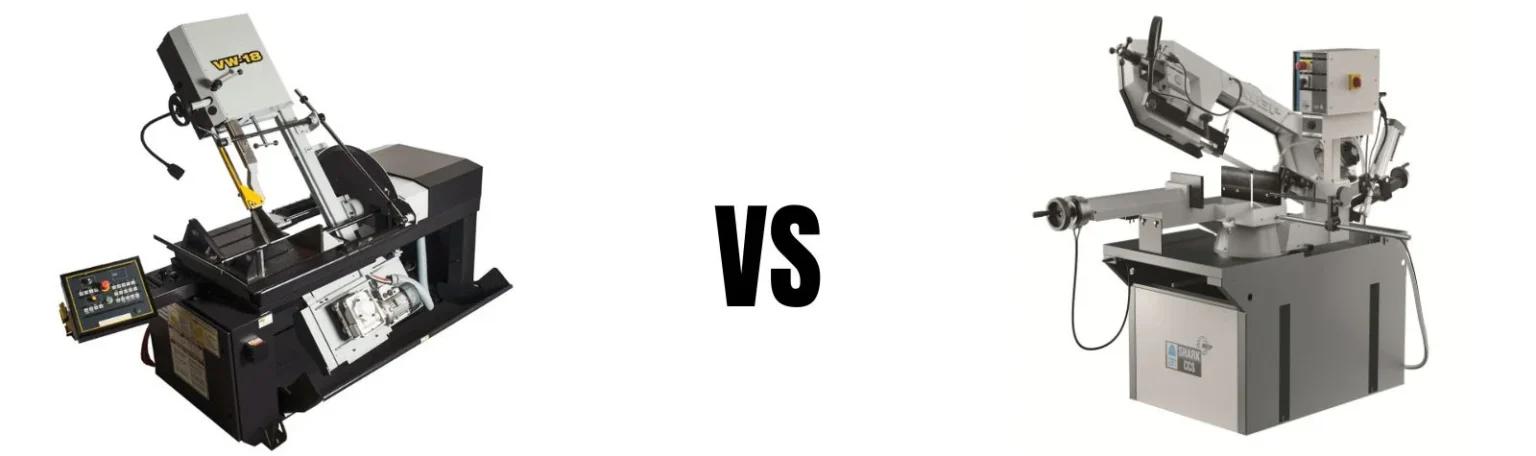
A horizontal metal bandsaw is designed for straight, repetitive cutting of bar, tube and structural steel.
A vertical metal bandsaw is used for contour cutting, plate work and custom fabrication.
Horizontal machines dominate production workshops, while vertical models suit flexible shaping applications.
Choosing between a horizontal bandsaw and a vertical bandsaw is one of the most important decisions for steel fabrication workshops. Both machines are widely used in metal fabrication, engineering and manufacturing environments across Australia, but they serve different cutting applications. Understanding the differences between horizontal and vertical metal bandsaws helps workshops select the most efficient machine for their production needs.
Both types are widely used across industrial applications — from structural steel processing to fabrication and maintenance workshops — but they serve different roles in a production environment.
It is also worth noting that traditional vertical contour bandsaws, once used for shape cutting, have largely been replaced in modern manufacturing by technologies such as laser cutting and wire EDM. Today, the vertical bandsaws commonly used in steel workshops are vertical tilt saws, designed for cutting bar, tube and sectional steel — not flat plate.
At Power Machinery, we supply leading MEP and Hydmech metal bandsaws, including manual, semi-automatic and automatic machines across Sydney, Melbourne, Brisbane, Perth and regional Australia. While horizontal bandsaws dominate due to their range, modern vertical tilt bandsaws offer excellent flexibility for fabrication environments where larger capacity, angled cuts and operator control are important.
This guide covers cut, accuracy, throughput, best-fit jobs, a full comparison table and FAQs, so you can pick the right metal bandsaw format with confidence.
What is a Horizontal Metal Bandsaw?
A horizontal metal bandsaw is the most common type of bandsaw used in steel fabrication workshops across Australia.
In a horizontal (pivot or dual-column) configuration:
- The saw head pivots or travels horizontally, and the blade cuts downward through the material
- Material is clamped in a vice; gravity or hydraulic feed regulates downforce, with servo/NC feed on production models
- The blade cuts downward through the material
- The head or vice rotates for single-mitre cuts; double-mitre models cut left and right without flipping stock
- The result is straight, repeatable cuts ideal for stock prep and production lists.
Horizontal bandsaws are designed primarily for cutting bar, tube and RHS, structural steel preparation, repetitive production cutting, and batch processing. They’re ideal for workshops processing steel daily and requiring consistent, accurate straight cuts with minimal operator intervention.
Key advantages of Horizontal Bandsaws
- A broad range of capacity and automation – from simple small-capacity manual machines to large capacity CNC-controlled saws
- Excellent straight cutting capability with strong hydraulic clamping for heavy materials
- High cutting efficiency and reduced operator involvement
- Automation options for production work
Horizontal machines are particularly well suited to automatic and semi-automatic operation, which is why most high-production metal cutting bandsaws used in Australia are horizontal
What is a Vertical Metal Bandsaw?
A vertical metal bandsaw used in modern steel fabrication is typically a vertical tilt bandsaw.
In a vertical tilt configuration:
- The blade runs vertically and is fixed in a loop; the operator moves the work across the blade on a table
- Feed is manual and operator-guided; jigs and fences help with straight or repeat cuts
- To mitre cut, the saw head tilts left or right
- The result excels at contours, copes, slots and notches that horizontal saws can’t do.
Vertical bandsaws are commonly used for sectional steel, tube, bar and packs (particularly suited to mitre cutting), fabrication work requiring angled cuts, steel supply centres and larger fabrication shops, and flexible cutting environments utilising jigs.
Examples of industrial vertical bandsaws include machines such as the Hydmech VW18, V18APC and V25APC, which are widely used in fabrication environments requiring flexibility and precision.
Key aDVANTAGES OF vERTICAL bANDSAWS
Vertical bandsaws offer several benefits in fabrication environments:
- Excellent flexibility for angled and mitre cutting, with the ability to raft cut multiple parts to equal length
- A flat table means jigs can be mounted for specialist work, such as trim cutting the green from bent tubes
- Compact machine footprint and versatility for varied cutting tasks
- Better material handling – long lengths can be lowered directly into the work area rather than rolled in from left or right as with horizontal saws.
Machines such as the Hydmech VW18 provide a simple and effective solution for workshops requiring manual flexibility, while models like the V18APC and V25APC add automated positioning features that improve accuracy and productivity.
Vertical bandsaws are particularly useful where materials, angles and cutting requirements change frequently.
Accuracy, Straightness and Finish
Horizontal Bandsaws
Dual-column frames provide the best straightness on heavy sections and solids. Hydraulic or servo downfeed maintains constant chip load for a clean finish, and vice rigidity plus guide alignment give predictable, part-to-part squareness.
Vertical Bandsaws
Excellent for precision shapes when guided with templates and fences. Straight, square cuts are possible, but repeatability relies on fixtures and operator technique. For long stock and structural sections, a horizontal saw’s vice and guided feed usually deliver tighter, more consistent tolerances.
Throughput: How Fast Parts Leave the Saw
Horizontal Bandsaws
Semi-automatic models use hydraulic clamping and a powered bow to cut cycle time and operator fatigue. Automatic/CNC models shuttle the vice to index bar to length, run cut lists, bundle-cut and count parts. This provides a significant uplift in pieces per hour, especially when paired with roller tables, bundle clamps and stops.
Vertical Bandsaws
Optimised for one-offs, prototyping, toolroom work and odd shapes rather than volume. Straight, square cuts are possible, but repeatability relies on fixtures and operator technique. Best productivity comes from pairing the saw with jigs or templates for repeat shapes.
HORIZONTAL VS VERTICAL BANDSAWS: KEY DIFFERENCES
Here is a practical comparison relevant to Australian steel workshops:
| FEATURE | HORIZONTAL BANDSAWS | VERTICAL BANDSAWS |
|---|---|---|
| Primary Use | Contour and shape cutting | Straight cutting of bar and tube |
| Cut Style | Vice holds work; head bow decends through material | Blade fixed, operator moves work on table |
| Automation | Manual, semi-automatic and fully automatic CNC | Typically manual with some automated positioning models |
| Mitres | Single or double-mitre options | Limited, needs jigs/fixtures |
| Production Volume | Medium to high | Low to moderate |
| Material Handling | Clamped vice system | Operator-fed |
| Best for | Structural steel, RHS, repetitive cutting, bundles and solids | Plate, irregular shapes, custom work, prototypes |
| Typical users | Fabricators, steel processors, production shops | Maintanence, R&D, jobbing/toolroom |
| Price Range | Entry to high level investment (depending on automation) | Typically lower investment |
The biggest distinction lies in production efficiency versus flexibility.
Need Help Choosing the Right Metal bandsaw?
Speak to our Australian team for expert advice on horizontal, vertical, automatic or semi-automatic models
Selection Checklist: 5 Quick Questions
- What’s 80% of your work? Straight lengths or shaped parts?
- Do you mitre alot? Double-mitre horizontals save time and handling.
- How many cuts per day? Semi-auto or automatic horizontals pay back fast over manual workflows.
- What materials and sizes? Structural sections and large solids favour rigid horizontals; intricate profiles prefer verticals.
- What’s your space and handling situation? Plan for roller tables and safe loading around horizontals; verticals fit tight toolroom spaces.
When should you Choose a Horizontal bandsaw?
A horizontal metal bandsaw is typically the right choice if:
- Capacity is less than 500mm x 400mm
- You cut mostly solid bar. Horizontal saws are excellent for both solid bar and sectional steel/tube.
- Budget mattersd and you don’t need the flexibility a vertical saw offers (vertical saws are generally the pricier option)
- You do not mitre cut.
Since most Australian businesses only require capacity up to 300mm x 250mm, horizontal bandsaws remain the primary production cutting solution for steel fabrication workshops nationally.
When should you Choose a Vertical Bandsaw
A vertical bandsaw is typically the right choice if:
- You require a lot of mitre or angled cuts
- Your work involves fabrication and custom components
- You handle long lengths in single pieces or packs, or benefit from raft-cutting multiple parts at once
- You need large capacity but floor space is limited
- Your structural steel work or steel supply centre could benefit from long automatic feed capability. Vertical saws are available with 3.0m automatic feed.
Machines such as the Hydmech VW18, V18APC and V25APC provide versatile cutting solutions for fabrication environments where materials and angles vary from job to job. Workshops focused on structural steel processing and high daily output will typically benefit from vertical bandsaws in semi- or fully-automatic configurations.
In many cases, growing fabrication businesses operate both horizontal and vertical machines, using each where it performs best.
MEP and Hydmech Bandsaws in Australia
- Manual horizontal bandsaws
- Semi-automatic horizontal bandsaws
- Fully automatic CNC metal bandsaws
- Vertical bandsaws
- Small to large capacity machines
- Nationwide delivery and support
Bottom Line
There is no single “best” bandsaw — only the right machine for your application.
If your work is mostly straight cuts, mitres, bundles or solids, especially in any volume, a horizontal band saw is the productivity and consistency choice. If you routinely do contours, copes, slots or prototypes, a vertical bandsaw delivers the shape flexibility a horizontal can’t match.
For most Australian steel fabrication workshops: horizontal bandsaws dominate due to their availability in smaller capacities; semi-automatic models in both formats suit moderate daily volumes; automatic bandsaws in both formats support scaling production; manual bandsaws suit entry-level operations; and vertical bandsaws excel at long-length cutting and workshops that spend considerable time on material handling. Many shops benefit from both; a horizontal for speed and a vertical for versatility.
Choosing the right configuration ensures your investment supports both current production needs and future workshop growth.
Need Expert Advice Choosing the Right Metal Bandsaw?
If you’re unsure whether a horizontal or vertical bandsaw is right for your workshop, call or email our metal machinery expert team.
With decades of experience supplying Hydmech and MEP bandsaws across Australia, we can recommend the right machine based on your material types, daily cutting volume and long-term business goals.
Explore our Full Range
- Automatic metal bandsaws
- Semi-automatic metal bandsaws
- Manual metal bandsaws
- Horizontal metal bandsaws
- Vertical metal bandsaws
- Our full Metal Machinery range
Or contact Power Machinery for expert advice on (02) 8445 8555 or email info@powermachinery.com.au
Trusted Australian Supplier
Supplying industrial metal bandsaws across Australia to fabrication, manufacturing and engineering workshops.
Industrial Grade Global Brands
Premium automatic metal saws from leading European and North American manufacturers including MEP and Hydmech.
Installation and Technical Support
In-house service department with full installation, commissioning and operator training available Australia-wide.
Finance & Flexible Purchasing
Finance options available to help workshops invest in the right metal cutting equipment for your needs.
Nationwide Delivery
Metal bandsaws delivered and supported across Sydney, Melbourne, Brisbane, Perth, Adelaide and regional Australia.
Frequently Asked Questions
The main difference is cutting orientation and production purpose. Horizontal metal bandsaws cut downward through clamped material and are ideal for straight, repetitive cuts in steel fabrication. Vertical bandsaws have a vertically positioned blade and are used for contour cutting, plate work and irregular shapes.
Yes, horizontal metal bandsaws are generally better suited for steel fabrication workshops that require consistent straight cuts of bar, tube and structural steel. They are also available in semi-automatic and automatic models for higher production efficiency.
A vertical bandsaw is best for contour cutting, shaping plate, toolroom work and custom fabrication tasks. They are commonly used where flexibility and operator control are more important than repetitive production output.
No. Horizontal saws are designed for straight cuts and mitres. For curves, copes and notches, use a vertical bandsaw.
Yes, with fences, mitre guides and good technique. For long stock or bulk straight cuts, however, a horizontal saw's vice and guided feed deliver more consistent squareness.
If you frequently cut angles on long stock, frames or rails, for example, double-mitre avoids flipping the material, which is faster, safer and more accurate.
If an operator spends more than an hour a day cutting, semi-automatic is the minimum you should consider. If you run cut lists or batches, an automatic saw with shuttle vice and NC indexing will lift pieces-per-hour and repeatability.
For workshops cutting high daily volumes, yes. They automate material feeding and cutting cycles, reduce manual handling, increase throughput and lower cost per cut over time.
Horizontal metal bandsaws, due to their versatility and range of automation options for structural steel and fabrication work.
Yes. They automate the cutting cycle but require manual material positioning, making them ideal for growing fabrication businesses with moderate production volumes.
Bi-metal blades cover most steels and stainless; carbide excels on large solids and tough alloys. Match tooth pitch to wall thickness and section size to avoid tooth strippage and a poor finish. You can order bandsaw blades for MEP saw here
For steel and stainless, flood coolant improves finish and blade life. For aluminium, mist or lubrication can be cleaner and just as effective — the key is keeping chips clear.
Often, yes. Many fabricators pair a horizontal band saw for throughput with a vertical saw for one-off shapes and toolroom tasks.